


A review of October’s reading and watching of fiction and some non-fiction. Due to the SubStack app updating to require iOS-newer-than-my-phone-allows I have read almost nothing on SubStack this month, I will look to rectify that next month. Not with a new phone (I use an iPhone 8 and will until it dies or a hand-me-down becomes available) but by sitting at my computer and reading instead of watching.
Books Read - 45/52
On Paper
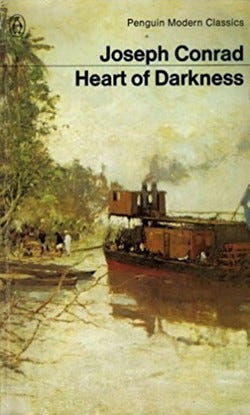
Heart of Darkness by Joseph Conrad
In 111 pages Conrad mogs almost every other writer past and present. Arresting from the beginning with a simple mystery Marlow finding out who Mr Kurtz is. Kurtz is built up to be this incredible, larger than life, character who is revered by many of the other people Marlow meets on his way into the African interior. At the same time we are shown a great deal of degradation along the way and all of that makes the meeting of Kurtz and finding him not to quite be what he is said to be feels a reasonable conclusion. There is more beyond that where Marlow comprehends what that means. Even though this is a century old novel many won’t have read it but you should.
Everyone is convinced that they can develop Africa, can turn a profit, can modernise the world with enough sweat and blood and money. But Marlow’s search for Kurtz reveals that this is false and not only is it false but it is detrimental to the Africans and the Europeans. One is being exploited, the other degraded, and neither is benefiting, both are being made sick by the venture. These are just my quick thoughts and, as with another book I read this month, I advise against accepting the prevailing analysis about a book, any book, and just read it yourself. There is no one correct interpretation, there are popular interpretations and unpopular ones, and some books have many readings and others few, all the more true when the author is dead and/or revealed little about their motivations and intentions.
Four Thousand Weeks by Oliver Burkeman
Four thousand weeks is almost eighty years, a decent length of life in “the West”. But what do most people do with their time? Fret it away worrying about time! Burkeman charts how we came to perceive time in the current zeitgeist, a way totally alien in the world before clocks where tasks took however long they took and demarcations around leisure and work were blurrier.
Most of the book is a good examination of the weird way we work and “manage our time/life” but it is a little repetitive, as many of these ‘self-help/smart thinking’ books can be, and he botches the landing in the final chapter where he answers common questions but gives answers counter to what he has said elsewhere in the book. He contradicts himself at other points, sometimes within a mere page or two, around how to approach politics and taking holiday from work. Some parts his atheism is overwrought and he spends paragraphs upon paragraphs working something out only to return to the Christian position but never realising it.
The Weird and the Eerie by Mark Fisher
Mark Fisher was a philosopher mostly known for his book Capitalist Realism: Is There No Alternative? but here, with The Weird and the Eerie, we have a book about literature, specifically fiction in the styles of H.P. Lovecraft, David Lynch, Stanley Kubrick, Alan Garner, and others, looking at which are weird and which are eerie, what the distinction between the two modes is, and how they don’t quite fit in horror or sci-fi or fantasy but instead form their own specific niche. All genres can include a sense of the weird and/or eerie, in the case of Margaret Atwood’s Surfacing, but they can also stand alone, such as in Lovecraft’s work, usually in the sub-genre weird fiction.
The book is a series of essays on various authors, filmmakers, and musicians, examining all the ways their work includes and explores the weird and eerie. Some of these essays are dense and on first reading I was unsure as to what they pertain but most are understandable the first go round, though such a book would benefit from multiple readings.
What are they then? Well both are strange but not horrifying and revolve around our fascination with the outside. Whether it be outside ourselves, outside perception, outside our culture/civilisation, outside human experience. Sometimes there is a sense of dread about it, but not full on terror.
The weird is that which does not belong, something has come in from the outside and can never be at home there. This can be objects, experiences, beings, unexplainable phenomena. The term weird originally meant fate or destiny and incorporates that which must happen but cannot be explained because the causality is a mystery to us, it is outside our understanding.
The eerie is also from the outside but focuses on agency. Something is applying its agency on us but we do not know or cannot know what it is. Also eerie are places, ruins, stone circles, places that we know have meaning but we can never know the meaning because it has been lost to time or it is alien to us. The monolith at the beginning of 2001: A Space Odyssey is a prime example of an eerie structure, one in which we think is constructed, thus implying higher intelligence and agency, but we never learn who built it or why and so it remains a relic of the outside imposing itself upon us (literally) and that conjures up the eerie feeling towards it.
The weird and the eerie can often be tangled up, this is especially the case with Lovecraft and any other writer who uses mysterious ancient artefacts as pathways to forbidden knowledge or beings.
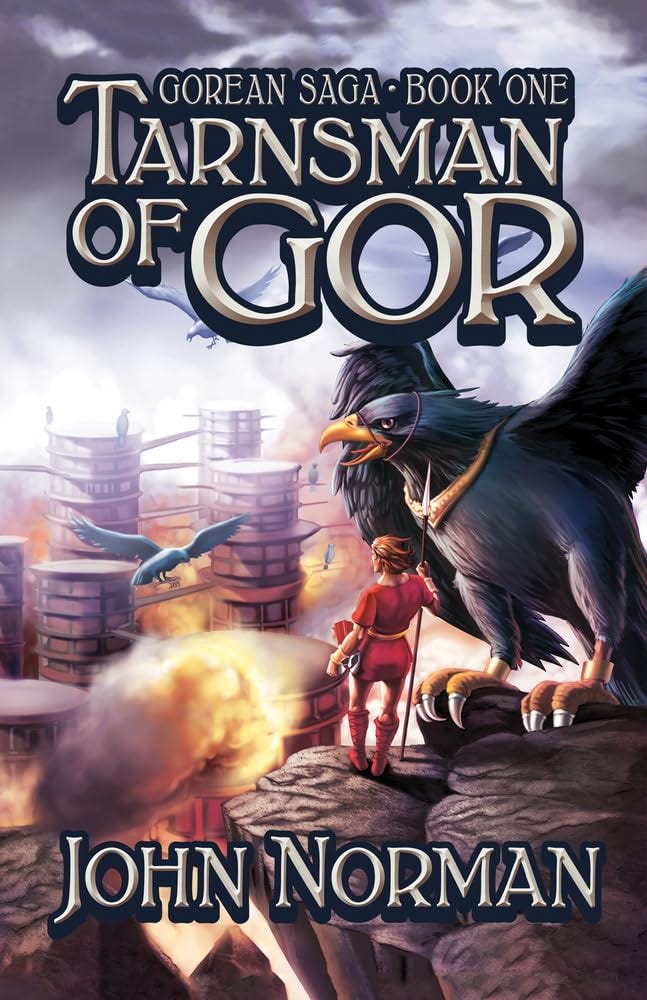
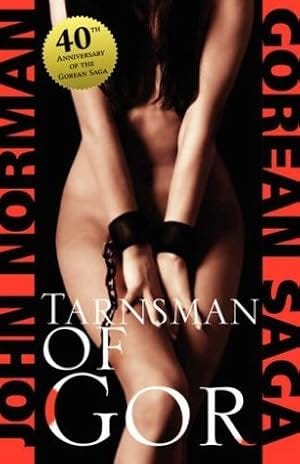
Tarnsman of Gor by John Norman
If ever there was a book I did not expect to find in my local library it was this one. The series, now a whopping 38 books long, is infamous for being UNpublished in the 1980s because of its depiction of women, slavery, sex slavery, bondage, submissiveness and the like, all the non-feminist things, alongside a sword-and-planet adventure reminiscent of John Carter. The cover of my local library copy did not help, the more recent cover, with Tarl and his tarn, is far more accurate to the contents of the book. Bear in mind this first book was first published in 1966 so it took awhile for 1. people to notice and/or 2. people to care. The series stopped at 25 books in 1988 before continuing in 2001 until 2024’s 38th release, Treasure of Gor. There may be more to come from the 94 year old, retired Philosophy professor, John Norman.
Based on what I had read about the Gorean Saga I expected something very graphic with regards to sex and violence, a real edge case in the fantasy genre.
That is not what Tarnsman of Gor is. In fact it is rather tame by today’s standards with the likes of romantasy and Bridgerton, the violence is on the grittier end but again not extreme by grimdark standards. The book is about Tarl Cabot, a man from Bristol, England, who is transported to a Counter-Earth, situated on the opposite side of the sun to our Earth in a perfect orbit as to never be visible to us. Those who live on this world, who are human, call their world Gor, or Home Stone in English. Tarl is transported to Gor by a flying saucer when hiking in the American wilderness after finding a letter from his father who he thought had disappeared long ago. Once on Gor he learns it is ruled from the shadows by the Priest-Kings who limit what technology is available the population via various methods resulting in a medieval/Hyperborean world structured around unending warfare between city states led by Warlords, or Ubars, during times of war, and Administrators during peace. Though Administrators sometimes lead during war too. There are plenty of arcane lore tidbits crammed into the rather svelte 180 page novel. Tarl Cabot meets his father, Mathew Cabot, Administrator of Ko-ro-ba, and learns the ways of Gor, the language, the fighting styles, the social structure (caste systems and the like), and all the rest. Once educated he is sent on a, frankly ridiculous, mission to steal the Home Stone of Ar during a festival. The Ubar of Ar has been conquering many cities and building an empire. Stealing Ar’s Home Stone will destroy it without having to fight. Tarl Cabot steals the Home Stone, and by chance the daughter of the Ubar of Ar who was principle in the festival atop on of the cylinders of Ar. She manages to fling him from his mount to almost certain death but Tarl, blessed as he is, and his luck is pointed out, that he must be blessed by the Priest-Kings themselves, survives by landing on a giant spider’s web.
Honestly the story is enjoyable and I was utterly unable to predict what the twists were going to be, adding to the enjoyment. The writing itself has a wonderful rhythm to it as well which makes reading a pleasure.
As to all the elements the series is reviled/revered for they are few and far between in this initial outing. Talena, daughter of the Ubar of Ar, is by no means a submissive woman, in fact a good 25 pages or more, of 180 total, are spent showing her repeatedly betraying or attempting to escape Tarl Cabot’s capture until she eventually relents but even when she has to pretend to be his slave to survive she is combative and risks ruining the whole ruse, which would lead to both of their deaths.
What is incredible about the book is how much Norman fitted into it without it seeming rushed or forced. The political machinations between the Ubar of Ar, Pa-Kur, Mintar, are well executed and kept to an alluring minimum, but minimum is not shallow. How the Priest-Kings operate and are everpresent without ever being seen or even close to the action maintains a mystery that does make me want to read more in the series. The way the combat develops is clear and cutting, reminiscent of Robert E. Howard. The exploration of rationality and humanity in Tarl’s dealing with the giant spider, Nar, is philosophically interesting and thoughtful. A great deal is accomplished with very little wordage.It’s clear that behind this book is a great tome of lore and worldbuilding, or at least the illusion of one, something which every fantasy/sci-fi writer aspires to.
I almost forgot to talk about all those raunchy sex scenes. There aren’t any. Tarl suggests he slept with a prostitute close to when he first arrives on Gor, then later on he sleeps with Talena and Norman describes it as “… after sweet hours of love making, we fell asleep in each other’s arms.”
The lesson from this is read things for yourself, come to your own conclusions, rather than the pre-made, pre-tinned, pre-digested ones of others. (But is this a pre-digested conclusion? Read and find out.)
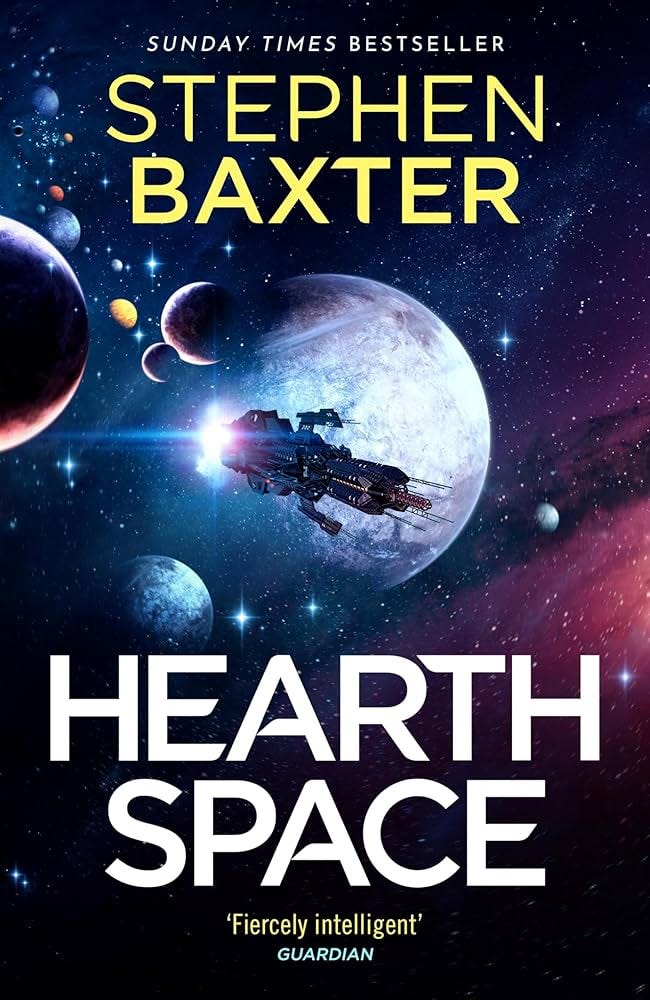
Hearthspace by Stephen Baxter
Words. Words. Words. Repetitive, excessive, increasingly boring. Horrendous book. Thankful this is a library book rather than something I bought.
The first 50 or so pages repeat the same worldbuilding information about Astronomical Units and types of planets numerous times, even having characters explain it to each other, characters who should already know said information. Too many characters make massive speeches with excruciating and boring details, reiterating things we have already read about seemingly for the sake of the reader. Even near the end details about the world and events are repeated as if Baxter thinks his readers suffer with long term memory issues.
The premise of the book is good, but ideas are easy, execution is hard, and this book is a prime example. The idea is that humans have colonised a distant system made up of thousands, if not tens of thousands, of worlds orbiting a dark-matter star. Two civilisations have emerged, the Hierarchy and the Alliance, who, due to the ludicrous distances involved, have forgotten about each other over the one thousand years since the colonisation ship reached what they call the Hearth. Not only that but knowledge of Earth has fallen into myth as well and so humanity no longer knows its origin. The Hierarchy, situated on the cold moons of Jupiter-like planets are a brutal society of slavery and tyranny, [and cruel to the point of caricature]. The Alliance, on the warm Earth, Mars, and Venus-like planets nearer the star, are democratic, tolerant, peaceful, [and naive like a young child is]. There is some exploration of why and how these two civilisations developed how they did but it is surface level.
The bulk of the story takes place on a Hierarchy vessel that is on an exploration to the Inner Worlds of Hearth space, where the Alliance is situated. This Hierarchy vessel immobilises and raids an Alliance vessel, enslaving the crew and carrying on its mission. The core of the story is ‘Atlantic slave ship in space’ with the mystery of human origin a significant side show. The idea isn’t the problem, it is the execution. The prose is dreadful, stilted, and, what read to me like, purposefully lacking rhythm, even breaking it on purpose to make reading a chore. There would be times when Baxter had a good thing going but then break it with an ellipses, a scene break, an em-dash, or, more often, a hyphen. Another weird choice includes ending sentences with a synonym of the word immediately prior separated by a comma, such as, “But the Hearth was more massive than the Sun, and much more powerful, intense.” [Highlighting my own.] What is the word “intense” doing there, it just hangs there not adding to the sentence, not moving the story along, or explaining the world, it merely hinders the rhythm of reading. This happens throughout the book, along with all other anti-prosody elements to create a start-stop feeling to the writing which is exhausting. I should have noted down more examples of all these egregious faux pas to show you but perhaps it is better I didn’t so we don’t spend too long on bad books.
On Film
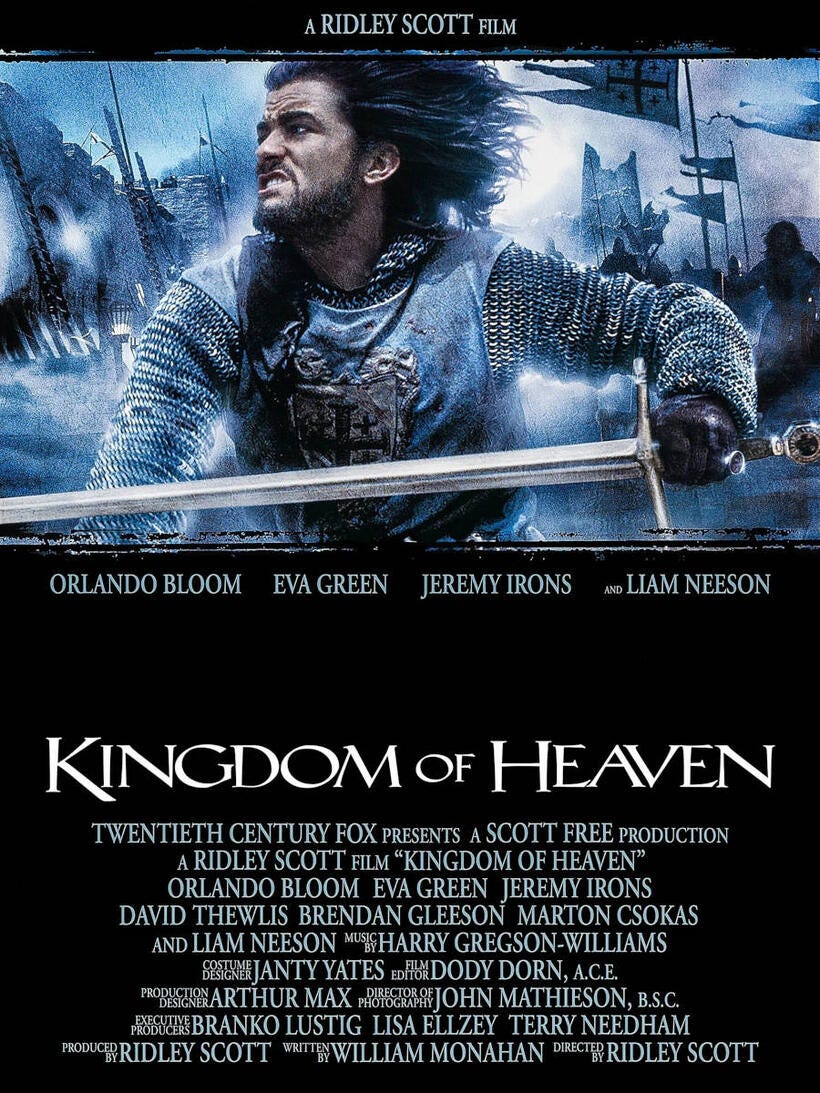
Kingdom of Heaven
I adore this film. The sets, the Harry Gregson-Williams soundtrack, the costumes, it’s sublime. Scott and Manahan took a great deal of liberties with the history of the period, but that is to be expected when crafting fiction and especially with a big budget movie that needs to appeal to a wide audience and make money.
The film follows Balian as he goes from blacksmith in struggling French town to Baron of Ibelin and Defender of Jerusalem before having to surrender the city to Saladin. Balian holds his Christian faith close but discovering the politics of court and the frivolous nature of some, not to mention the blood thirstiness of the Templars, he is beset by doubt and while his actions, and certain events around him, reveal the truth of God he is never certain.
Matters of faith and religion feature throughout, a distinction that is made clear at times and less at others, and while the aim is to critique religion and faith it ultimately fails due to narrative requirements and depiction. The war being between Christian and Muslim is mentioned a lot but differences are explored only upon the surface. Given the film is from Balian’s point-of-view this makes sense, he is a Frankish Catholic commoner thrown into the world of noble intrigue and fraught diplomacy with little education in any of it. His pureness of heart and desire to be a “good knight” means he is seen as naïve by the court of Jerusalem but ultimately this pureness is what saves the people of the holy city.
Some characters are far, far removed from their historical counterparts, Princess Sibylla, she was in fact devoted to her husband, and Reynald de Châtillon who was a firm supporter of Guy de Lusignan and did raid Muslim trade caravan, he had been imprisoned by the Muslims for fifteen (15!) years. Once freed he had lost his Princedom of Antioch so returned to Jerusalem were Baldwin IV, the Leper King, invested him with Oultrejourdain which oversaw the major trade routes between Egypt and Syria which Saladin relied on. Later Reynald served as regent when Baldwin IV was too ill to rule himself. I highly recommend the book God’s Wolf by Jeffrey Lee which is an auto-biography of Reynald de Châtillon to learn more.
Even with the historical inaccuracies this film is plenty enjoyable, I do like the character of Reynald in the film too even if he isn’t most accurate, after all we are dealing with fiction and not a documentary.
On Video
This one hour video delves into the reasons why contemporary prose, at least in trade publishing, is so poor where every writer seems to share the same voice and nothing is written with any depth. The first section is focussed on how children are taught to read, in the United States at least. In Britain we are still taught via phonics or synthetic phonics but it seems the States has succumbed to whole word which has had a measurable negative effect on literacy. Fascinating stuff.

Many thanks for reading, see you next month in which I aim to have read more independent books and writers here on SubStack!
Expect a short story next Tuesday!
Catch up with my ongoing serial The Mage Hunter here: